On the lever
On mobile devices, read the page in horizontal/"landscape" mode. Otherwise math may not fit the screen.There’s an interesting Youtube video where the science youtuber guy, Vsauce, discusses torque with Alex O’Connor, a Youtube philosopher of some kind. He asks for an intuitive explanation of why, say, the lever works. It does seem a little bit strange. Why should fixing a pivot point help you lift a greater weight at the other end? Even children know that levers work, but why? Sure, you can write $F_1r_1 = F_2r_2$ and out comes the lever law immediately, but this is begging the question: why should those two things be equal?
I paused the video, worked on the problem a bit, and then later ended up listening more and discovered they mention this (pdf) paper. Well, I did my model independently, so it’s not quite the same as there – but that article is pretty good at explaining it. The idea is similar but not quite the same.
I reason as follows. A lever is a system that consists of some number of parts connected to each other, and fixed upon a pivot. The pivot acts as a boundary condition – whichever part touches the pivot is not moved when you push on the lever. The parts of the lever are some distance apart. The simplest case is that it consists of three parts, like so:
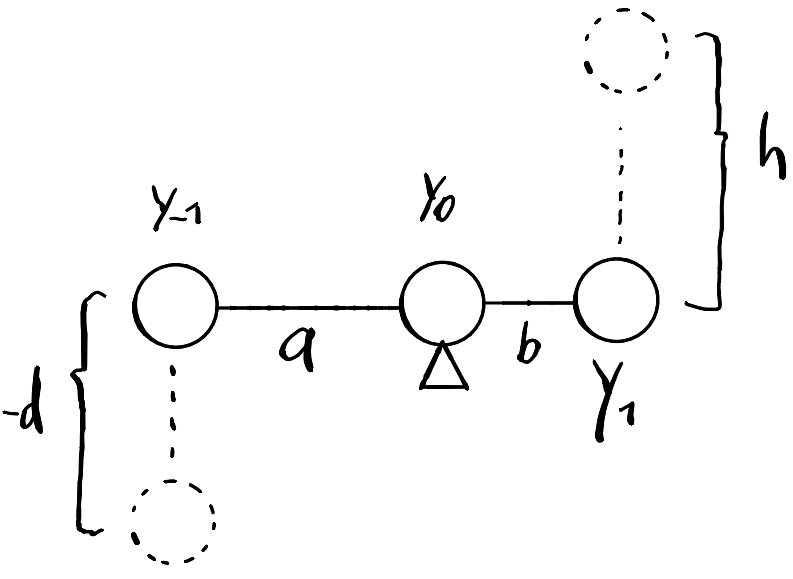
The lever is a rigid object. This means that there must be some force that keeps these three parts in a straight line. This force cannot be of the nearest-neighbor type, because the pivot would stop the force from propagating along the rod (since it never moves). It must instead be next-nearest neighbor. If $y_i$ are the heights of the parts of the lever (measured from, say, the horizontal lever, where the pivot is at $y_i = 0$) numbered as in the picture, then the simplest nearest-neighbor force would be
\[F_{i} \propto (y_{i-1}-2y_i+y_{i+1})\]or in other words, the second difference of $y_i$. More generally, it is the difference between the slopes of $y_{-1}$ with $y_0$, and $y_0$ with $y_1$. Write $s_{-1,0} = (y_{-1}-y_0)/a, s_{0,-1}=(y_0-y_1)/b$. Then the corresponding potential energy is
\[U_3 = \frac{1}{2}\kappa (s_{-1,0}-s_{0,1})^2 = \frac{1}{2}\kappa \bigg( \frac{y_{-1}}{a}-\bigg[ \frac{1}{a}+\frac{1}{b} \bigg]y_0 + \frac{y_1}{b}\bigg)^2\]Now push the left side lever down some distance $-d$, i.e. $y_{-1} = -d$. The right side will (perhaps) rise some distance $y_1=h$. The pivot stays fixed $y_0=0$. Plugging in, we obtain
\[U_3 = \frac{1}{2}\kappa \bigg( \frac{h}{b}- \frac{d}{a} \bigg)^2 := \frac{1}{2}\kappa q^2\]We can now compute the forces for the left and right sides. We obtain
\[F_{-1} = -\frac{\kappa q}{a}, \quad F_{1} = -\frac{\kappa q}{b}\]Note that this is the force experienced by the part of the lever; if we’re pushing the left side down, we are applying $-F_{-1}$. We see now that
\[\frac{F_{1}}{F_{-1}} = \frac{a}{b}\]which is just the lever law.
This mechanism can actually be extended to the case of multiple parts in the lever. Suppose now that there are ten parts on the left, then the pivot, and two on the right. See the picture:
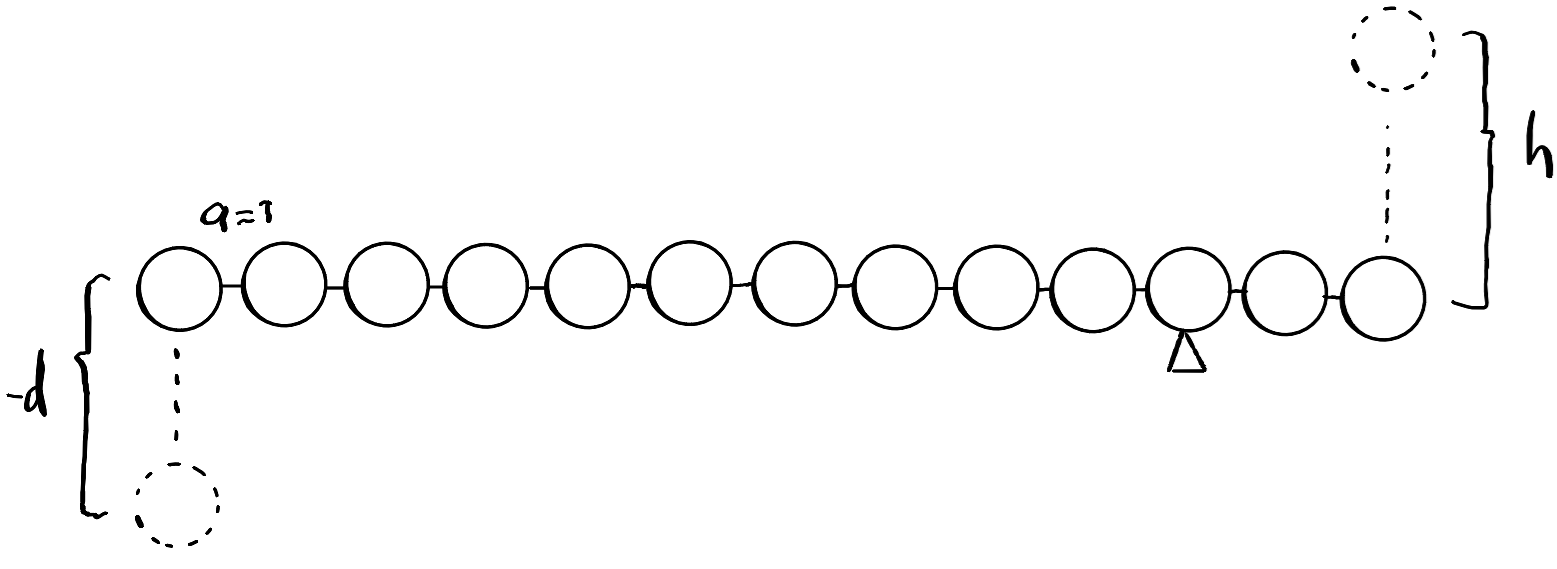
In that case,
\[U = \frac{1}{2}\kappa \sum_{-9}^1 q_i^2, \quad q_i = y_{i-1}-2y_i+y_{i+1}\]It is possible but a little bit arduous to see that
\[q_{-9} + 2q_{-8} + 3q_{-7} + \dots + 10q_0 + 5q_1 = 5h-d \label{eq:telescope}\]The energy is proportional to the squares of $q_i$, and it must satisfy $\eqref{eq:telescope}$. Therefore the $q_i$ must satisfy
\[(q_{-9},...,q_1) = C(1,2,3,...,10,5)\]for some proportionality constant $C$. Taking the inner product with $(1,2,3,…,10,5)$ on both sides, we obtain
\[5h-d = 410C \implies C = \frac{5h-d}{410}\]We can now plug this into the energy expression and compute the left- and rightmost forces. We arrive at
\[F_{-10} = -\kappa q_{-9},\quad F_2 = -\kappa q_1\]which once again produces the lever law, since $5q_{-9} = q_1$ and there are five times as many parts on the left as the right.
Final thoughts
In this model, the lever works as a force multiplier because it wants to remain straight. The extra force is basically supplied by the internal bending energy of the lever itself. The condition that the pivot point remain stationary provides a constraint that fixes the relative positions.
It is relatively “easy” to see that a similar identity can always be found for any number of parts on the left and right hand sides. I leave it as an exercise to the reader. The point is that whether you have just three parts with varying distances between them, or several parts on each side with fixed distances, the end result is the lever law anyway.
We have not, of course, explained why the lever should want to remain straight. This is, in fact, a very difficult question. A satisfactory answer can only be calculated from quantum mechanics.